All Blacks tear up the script as Springboks suffer bruising first-Test defeat in Johannesburg
23 Aug, 2026
All Blacks tear up the script as Springboks suffer bruising first-Test defeat in Johannesburg
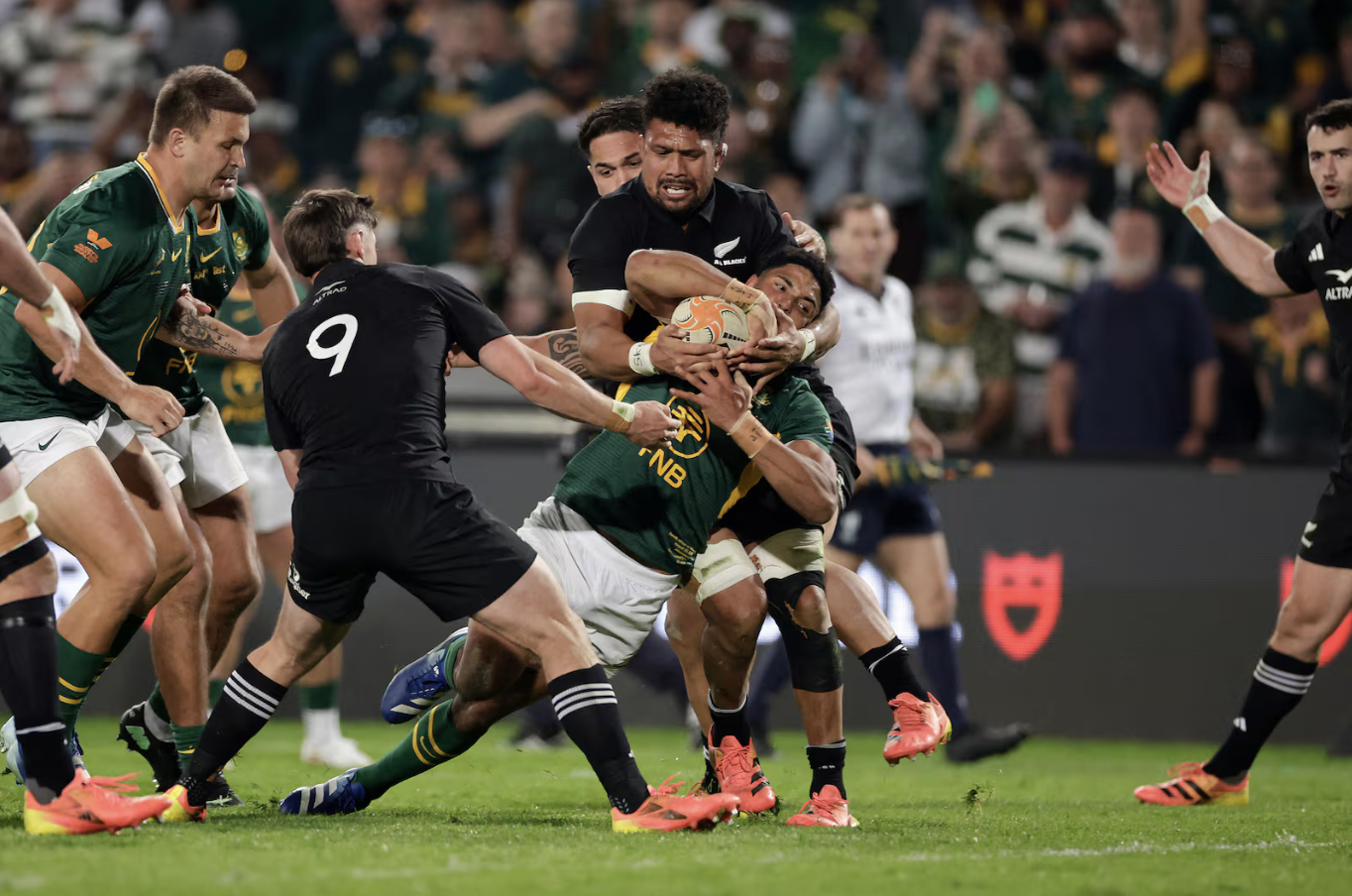
South Africa's Springboks jolted by a result few saw coming after the All Blacks overpowered them 33-16 at Ellis Park on Saturday, seizing a 1-0 lead in Rugby’s Greatest Rivalry and turning the first Test into the biggest story in the game on Sunday, 23 August 2026.
The scoreline alone was emphatic. The context made it more striking. The Springboks led 13-12 at half-time, had periods of clear set-piece authority and repeatedly forced New Zealand into uncomfortable territory, yet still finished on the wrong side of a five-tries-to-one defeat. It was a loss shaped less by a lack of pressure than by an inability to finish it, while the All Blacks were far sharper in the moments that mattered.
Will Jordan struck twice for New Zealand, with Josh Moorby, Fabian Holland and Luke Jacobson also crossing. Ruben Love added four conversions. South Africa’s only try came through Andre Esterhuizen, while Cheslin Kolbe supplied the rest of the points with a conversion and three penalties. The visitors’ second-half surge transformed a tight contest into a statement win and handed the Springboks an immediate recovery mission before the second Test in Cape Town next Saturday.
The match was packed with the kind of mini-battles that usually decide meetings between these sides, and New Zealand won more of them than seemed likely during the opening hour. Up front, South Africa initially appeared to have the upper hand at scrum time. The Springboks generated repeated pressure and won penalties, with Kolbe’s boot keeping the scoreboard moving. Yet the key twist came when New Zealand’s replacements steadied the set piece and eventually flipped that contest. A scrum penalty conceded by South Africa on their own feed, with the deficit only three points in the 58th minute, proved one of the game’s defining moments. Instead of building another assault, the Springboks lost territory, momentum and control.
At the gainline, Jasper Wiese and Pieter-Steph du Toit asked hard questions of the All Blacks defence, especially in the first half. But New Zealand’s response in contact was disciplined and resilient rather than spectacular, and that defensive composure kept South Africa from converting dominance into tries. One sequence summed it up better than any other: Malcolm Marx looked set to score before Jordie Barrett disrupted the finish and forced the ball loose. In a fixture decided by ruthlessness, that was one of the clearest dividing lines.
The halfback duel also tilted decisively the All Blacks’ way. Cam Roigard’s tempo and decision-making helped New Zealand play with clarity even when South Africa were squeezing the contest physically. Grant Williams, by contrast, found himself under heavy pressure. The most damaging single play of the match came early in the second half when Fabian Holland charged down Williams’ clearing kick, regathered and scored. It was not just seven points. It was the moment the emotional balance of the Test swung sharply towards the tourists.
Out wide, Jordan and Moorby turned limited opportunities into major damage. Jordan’s finishing punished South Africa whenever defensive shape loosened, while Moorby’s try underlined the contrast in efficiency between the teams. New Zealand did not need long spells of territorial dominance. They needed only a few clean chances and took them with conviction.
South Africa’s backline combinations never settled fully once injuries and disruption bit. Esterhuizen crossed after replacing Kurt-Lee Arendse, but the Springboks were too often inaccurate in the red zone, either through handling errors, forced turnovers or imperfect decisions. For all the noise and physicality of Ellis Park, the home side’s return on their visits deep into New Zealand territory was far too low for a match of this magnitude.
Discipline and accuracy widened the gap late on. As the pressure built, South Africa’s error count climbed and New Zealand’s control grew. The All Blacks finished with the stronger bench impact, the cleaner execution and the far better strike rate when chances opened. Two late yellow cards against the Springboks only reinforced how firmly the game had slipped away by the closing stages. (For the Nations Championship picture, the result matters well beyond one rivalry chapter. South Africa came into this block as one of the standard-bearers of the new global competition, but the first major hit has landed early and heavily). The Springboks are now searching for solutions to a defeat built on missed chances in areas they usually dominate.
That is what makes this such a significant Sunday story. The All Blacks did not merely edge a classic. They absorbed the Springboks’ strongest weapons, countered with sharper tactical execution and left Johannesburg with a result that changes the mood of the series. The next Test in Cape Town already carries the pressure of a decider for South Africa’s hopes of turning the rivalry back in their favour.