Rugby's Greatest Rivalry Returns: Why the All Blacks Have Picked Power Over Polish
27 Jul, 2026
Rugby's Greatest Rivalry Returns: Why the All Blacks Have Picked Power Over Polish
The road to the 2027 Rugby World Cup is about to become considerably steeper.
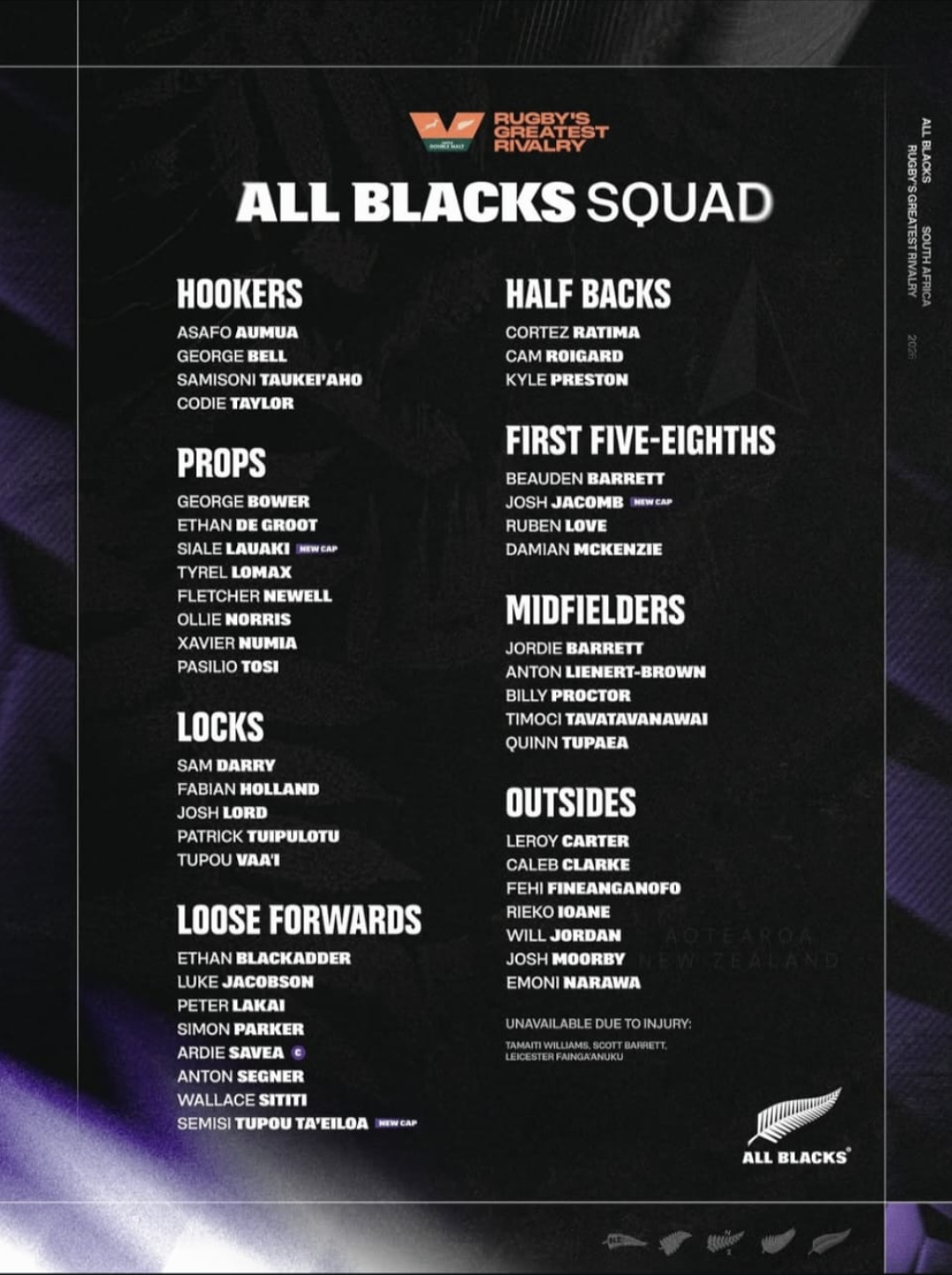
Fresh from an unbeaten opening block of the inaugural Nations Championship, New Zealand have doubled down rather than refreshed, naming a 44-man touring squad for what is being billed as Rugby's Greatest Rivalry Tour—a seven-week campaign featuring four Tests against world champions South Africa, alongside fixtures against leading South African franchises. Rather than reinventing the wheel, head coach Dave Rennie has retained every player from his original Nations Championship squad and supplemented it with ten reinforcements, signalling continuity over experimentation.
That decision tells you exactly where New Zealand believe this series will be won.
This won't be a beauty contest
The Springboks remain rugby's benchmark because they dictate collisions before they dictate territory.
Against England, Scotland and Wales in the Nations Championship, South Africa's blend of suffocating defence, aerial dominance and relentless forward pressure once again demonstrated why few teams are comfortable chasing games against them. Rennie knows matching physicality is non-negotiable before any expansive ambitions can emerge.
That explains perhaps the most fascinating selection.
Loose forward Semisi Tupou Ta'eiloa has yet to earn an international cap, yet few players in Super Rugby Pacific carried the ball with greater menace this season. His statistics explain the excitement: 205 carries—the competition's highest total—seven tries and almost every minute of Moana Pasifika's campaign played. Those aren't merely impressive numbers; they indicate extraordinary durability combined with relentless work rate.
South Africa traditionally forces opponents into repeated collisions until defensive systems begin to fragment.
Tupou Ta'eiloa is exactly the kind of player capable of preventing that.
The chess match begins at fly-half
Perhaps the biggest subplot surrounds No.10.
Ruben Love impressed throughout the Nations Championship, earning Rennie's trust with composed game management against France, Italy and Ireland. Yet the veteran Beauden Barrett now returns for what may become the defining stretch of his international career after watching much of the July campaign from the sidelines. Josh Jacomb, another uncapped inclusion, adds further depth, while Damian McKenzie remains rugby's ultimate attacking accelerator.
This creates an intriguing tactical dilemma.
Against most nations, New Zealand can afford to prioritise creativity.
Against South Africa, territory frequently outweighs flair.
Expect Barrett's long tactical kicking, aerial control and experience to become increasingly valuable if the Springboks dominate set-piece possession. Conversely, Love offers quicker distribution and sharper tempo when New Zealand earn front-foot ball.
Which philosophy wins may define the entire series.
Width versus weight
The All Blacks still possess devastating strike weapons.
Will Jordan remains among world rugby's finest support runners.
Jordie Barrett provides perhaps the game's most complete midfield presence—power, kicking range, defensive organisation and decision-making wrapped into one player.
Cam Roigard continues to inject tempo from scrum-half.
But South Africa rarely lose because opponents lack attacking talent.
They lose because they surrender the gain line.
Expect New Zealand to attack wider than they did throughout the Nations Championship, targeting the space behind South Africa's aggressive defensive line with cross-kicks and second-phase width. The challenge will be generating sufficiently quick ruck ball before the Springbok back-row arrives.
That contest—clean ball versus defensive disruption—is where every Test may ultimately swing.
Selection reveals long-term thinking
Another notable feature is balance.
Three uncapped players arrive, several experienced internationals return, while established leaders including captain Ardie Savea remain central despite injuries sidelining Scott Barrett and Tamaiti Williams. It is succession planning without sacrificing competitiveness.
With eight matches compressed into six demanding weeks, squad depth isn't simply insurance.
It is strategy.
Rotation will become essential, particularly among the front five where South Africa's famous "Bomb Squad" philosophy has redefined modern Test rugby.
GameDayBuzz Watch
For GameDayBuzz players, this series offers plenty of predictive angles.
Watch first-phase dominance. If New Zealand consistently generate quick ruck speed and force the Springboks to retreat rather than launch defensive line speed, the All Blacks become exceptionally dangerous.
Keep an eye on Semisi Tupou Ta'eiloa. If he translates his remarkable Super Rugby carrying numbers into Test rugby, he could become the breakout story of the tour.
And monitor the fly-half selection. Barrett's tactical kicking versus Love's attacking rhythm may become the week's biggest selection debate before every Test.
Prediction: South Africa remain deserved favourites over four Tests because of superior set-piece depth and home familiarity. However, New Zealand's expanded squad suggests they aren't arriving merely to survive the collision battle—they intend to win it. Expect the Springboks to edge the series 3-1, but don't be surprised if one or two encounters are decided by fewer than seven points. The rivalry has rarely allowed anything else.